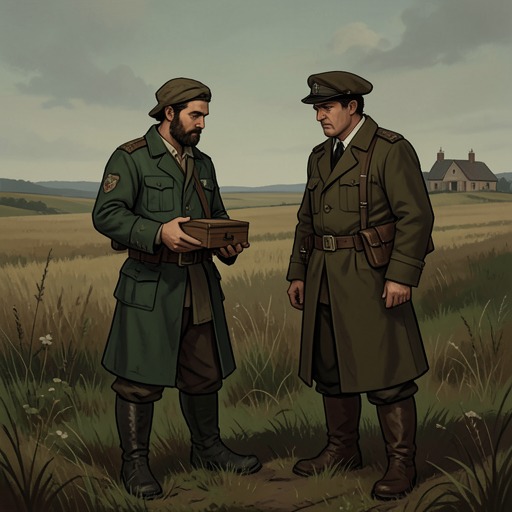
Thobela Mpayipheli and Pakamile Nzululwazi: fatherlike closeness
Heart of the HunterThobela Mpayipheli and Pakamile Nzululwazi share a fatherlike relationship made visible in ordinary routines: a greeting at the end of the workday, time spent tending a vegetable garden, and evenings reading together. Their closeness is not merely an idea attached to Thobela’s hopes for family life. It is built through repeated acts of attention and care. When Thobela’s debt to Johnny Kleintjes draws him away from home, the boy’s trust makes the cost of that choice immediate; later, Pakamile’s disappearance becomes one of the central stakes of Thobela’s struggle to protect him and return to a life beyond violence.
A Bond Built into the Daily Routine
On the road home to Guguletu, Thobela’s motorcycle carries him toward both Miriam Nzululwazi and Pakamile. The boy waits on a street corner and runs the last thirty metres beside the Benly to the driveway. Thobela removes his helmet, lifts down his tin workbox, and greets him with a hand swept over his head. Pakamile answers with a smile and throws his arms around him. The small sequence recurs as a daily welcome: work gives way to home, and the child’s eagerness meets Thobela’s attention before he goes inside to Miriam.
The relationship is also part of a household shared with Miriam, not an isolated bond between the two. She is often occupied with cooking, washing, or cleaning when Thobela arrives, and she recognizes how attached her son is to him. Thobela knows the feeling is mutual. The text presents this as a family in practice: affection is expressed through the ordinary return home, the child’s welcome, and the expectation that the evening will continue together.
The Garden and the Work of Teaching
After changing his clothes, Thobela takes Pakamile into the yard to inspect their garden. Their walk is a shared project with its own daily measures: the growth of the sweetcorn and its cobs, the runner beans, carrots, squashes, butternuts, and watermelons. They test a carrot before it is ready; Pakamile later rinses it to show Miriam and eats it raw. Together they check for insects and look over leaves for fungus or disease. Thobela explains what they see, while Pakamile listens with solemn concentration.
The garden gives their closeness a practical, forward-looking form. Thobela does not simply entertain the child; he includes him in observation, judgment, and care. The harvest is still developing, and the two return to it to notice what has changed over the last day. When Thobela imagines leaving the cycle of poverty and crime behind with Miriam and Pakamile, a new beginning by the Cala River, the plan extends a hope already enacted in the yard: that they might cultivate a different life together.
Learning, Promises, and an Unexpected Departure
Evenings bring another shared practice. Thobela and Pakamile sit at the kitchen table with a large blue atlas and National Geographic magazine while Miriam sits slightly apart with her needlework. One evening they read about Chile, first in English and then paragraph by paragraph in Xhosa, using the atlas to find the country and examine its map. They usually read no more than two pages because Pakamile’s attention fades, except when an article concerns a dangerous animal. The routine joins companionship with Thobela’s effort to help the boy learn.
On this evening, however, Pakamile keeps looking toward a blue sports bag by the door. Thobela tells him that he must go away for a day or two to help an old friend, and asks him to keep the journey secret. Pakamile wants to come too. Thobela promises that one day he will take him, then says he will leave once the boy is asleep and be away for only about two sleeps. He asks Pakamile to look after Miriam and the vegetable garden; Pakamile agrees and asks whether Thobela will bring him cake. The exchange is gentle, but its details establish what departure will interrupt: shared journeys, daily responsibilities, and the boy’s confidence that Thobela will come back.
Thobela’s decision is bound up with his debt to Johnny Kleintjes. He tells Miriam that leaving his former life was a genuine choice and that he still intends to choose the right way, but he understands honour to include paying a debt as well as caring for her and Pakamile through lawful, non-violent work. That reasoning puts his obligations into conflict. The bond with Pakamile is part of the life Thobela wants to preserve, while the old obligation takes him away from it and exposes the household to danger.
Separation and the Stakes of Protection
As the crisis deepens, Thobela’s hope of changing his life remains connected to the boy. He imagines that if he and Miriam can take Pakamile to the Cala River, they might begin again beyond crime and hardship. His reflection that one person’s change might help shift the wider balance gives the private plan a larger reach, but it does not make the family’s immediate risk abstract. Pakamile is the child Thobela has taught and cared for, and the future he wants to protect is a specific household and garden.
The separation becomes acute after Miriam’s death. In his written admission, Vincent Radebe states that he unlawfully abducted her six-year-old son and kept him at his home overnight, then handed Pakamile to personnel of the Cape Times the next day. The statement also links the abduction to Radebe’s conduct during the Presidential Intelligence Unit operation. For Thobela, the boy’s safety is no longer simply a hope attached to his return home: Pakamile has been taken out of the household, and Thobela must find out where he is.
When Thobela asks where Pakamile is, Allison Healy tells him that the boy is safe. Thobela then sets a specific arrangement: Pakamile must be brought to the underground parking lot at the Waterfront at eleven the following morning, or he will send a copy of the hard disk to newspapers across the country. The deadline binds the two threads of his crisis—the child’s return and the dangerous information he carries. His insistence on Pakamile’s location shows the relationship’s practical force: the boy’s safety is a condition around which Thobela organizes his next move.
Reunion and the Life Beyond Violence
At the final convergence, Thobela sees Pakamile, and the emotion of the moment nearly overwhelms him. The reunion is presented as a response to all the earlier absences: the interrupted garden evenings, the journey undertaken without the child, and the uncertainty over his whereabouts. The hard disk is reported safe, though not in the possession of the people making that report, while Thobela’s attention turns to the boy he has recovered. The two forms of security remain distinct, but the child’s return is the intimate resolution the relationship has been moving toward.
The closing image carries them back toward family and cultivation. Reverend Lawrence Mpayipheli is working among his tomato plants when he hears a motorcycle outside. Two riders—a large man and a little boy—have arrived, and he waits for them to remove their helmets before calling to his wife. The garden that frames this meeting echoes the earlier vegetable patch Thobela shared with Pakamile. Their fatherlike closeness is therefore not only a source of tenderness or a measure of what the pursuit costs; it helps define the alternative Thobela seeks. Care, teaching, and the possibility of returning together stand against the violent obligations he has struggled to leave behind.